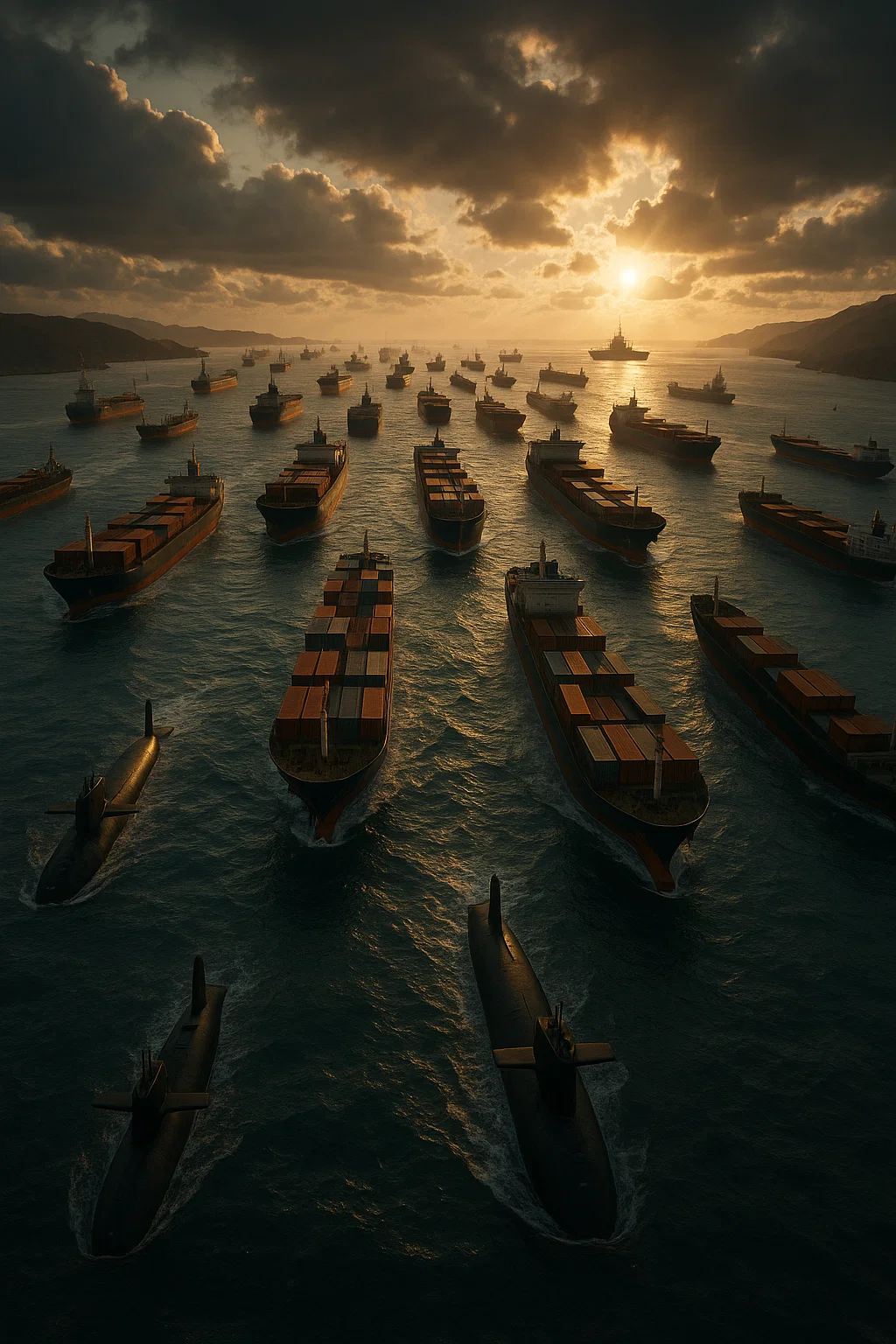
The Geography of Choke Points: Future of Sea Denial in the Indian Ocean
Why Geography Still Decides Power
Technology often dominates the conversation on modern warfare, drones, cyberattacks, AI-driven surveillance. But geography still calls the final shots. In the Indian Ocean, a handful of narrow straits act as hinges of global power. Nearly 80% of the world’s trade by volume and 60% by value moves by sea, much of it squeezed through just four chokepoints. Whoever secures or disrupts these waters gains leverage that goes far beyond shipping lanes.
History reminds us that choke points have always mattered. During the Second World War, Japanese forces relied heavily on the Malacca Strait to sustain their campaigns, making it a constant Allied target. In the 1980s, the “tanker wars” in the Strait of Hormuz sent oil prices swinging wildly. These lessons continue to echo: geography may be permanent, but power balances around it are not.
The Indian Ocean’s Four Pressure Points
Strait of Hormuz - The most famous bottleneck. Roughly one-fifth of global petroleum flows through here daily. The smallest disruptions from mining incidents to political standoffs ripple through global markets almost instantly. Iran has repeatedly used the threat of closing Hormuz as a strategic lever.
Strait of Malacca - Among the busiest waterways on earth. Roughly 60,000 ships transit each year, carrying a third of global commerce. For China, it is the lifeline: more than 60% of its imported oil flows through this single corridor. Yet Malacca is just 1.7 nautical miles wide at its narrowest point, making it highly vulnerable to interdiction.
Sunda and Lombok Straits - Less famous, but important alternatives through Indonesia. They are deeper and can accommodate larger vessels than Malacca. But taking them adds days to voyages and raises costs, meaning they are fallback routes rather than preferred paths.
Bab el-Mandeb - Linking the Red Sea to the Arabian Sea, this narrow gate controls access to the Suez Canal and beyond to Europe. Nearly a tenth of world trade moves through here. Recent Houthi drone and missile strikes have shown how vulnerable this route can be to asymmetric threats.
These choke points are not just shipping arteries. They are strategic chokers - natural levers of denial, coercion, and power projection.
China’s “Malacca Dilemma”
No country fears choke points more than China. Former president Hu Jintao warned in 2003 that Beijing’s reliance on Malacca made it dangerously exposed. Two decades later, little has changed. Despite heavy investments in alternatives, pipelines from Myanmar to Yunnan, the China-Pakistan Economic Corridor via Gwadar, and overseas naval bases in Djibouti and Sri Lanka, over 60% of China’s energy imports still flow through Malacca.
This vulnerability explains China’s push to build a blue-water navy, invest in long-range anti-ship missiles, and deepen influence over Indian Ocean littorals. For Beijing, Malacca remains the “soft underbelly” of its rise, a vulnerability that adversaries could exploit in any crisis.
India’s Geographic Advantage — and Strategic Dilemma
India, by contrast, sits at the crossroads. To its west lies Hormuz, within easy reach of its naval bases. To its east, the Andaman & Nicobar Command places India right at Malacca’s doorstep. Geography gives India a rare opportunity: the ability to influence two of the world’s most critical choke points simultaneously.
But advantage is not strategy. India faces a doctrinal dilemma:
- Sea Control - Building and deploying carriers like INS Vikrant to dominate open waters.
- Sea Denial - Relying on submarines, BrahMos missiles, and drones to block adversaries at choke points.
- Alliance Balancing - Deepening ties with the Quad and AUKUS to multiply reach and share burdens.
Within India, debate continues. Advocates of carriers argue they project power and prestige. Critics counter that submarines and missiles provide more cost-effective denial in contested waters. Without doctrinal clarity, India risks spreading resources too thin.
The U.S. and Its Allies: From Policemen to Partners
The United States remains the only truly global navy. Its Fifth Fleet in Bahrain secures Hormuz and Bab el-Mandeb. The Seventh Fleet in Japan projects across Malacca. Diego Garcia provides a vital logistics anchor in the middle of the Indian Ocean.
Yet overstretch looms. Washington faces simultaneous commitments in Europe, the Pacific, and the Middle East. To sustain its role, it leans increasingly on allies. Australia’s nuclear-submarine program under AUKUS, Japan’s expanding maritime forces, and European bases in Réunion, Mayotte, and the British Indian Ocean Territory are all parts of a shared effort to keep sea lanes open. In practice, alliances act as multipliers of U.S. presence, ensuring no single nation bears the full cost of guarding global commons.
The Quiet Kingmakers: ASEAN and Middle States
While major powers grab headlines, smaller states often tip the balance. Singapore has turned itself into the region’s premier logistics hub, tightly integrated with U.S. naval operations while maintaining deep economic ties with China. Indonesia, controlling Malacca, Sunda, and Lombok, is courted by both sides but resists formal alignment, preferring strategic autonomy.
ASEAN as a whole follows a careful hedge: trading heavily with China while relying on U.S. security guarantees to deter coercion. The result is subtle but significant. In many ways, Southeast Asia acts as the swing vote in Indian Ocean geopolitics, not through outright military power, but through its control of geography and its refusal to be drawn fully into either camp.
Technology: Amplifier, Not Equalizer
New technologies are transforming naval warfare, but instead of diminishing the role of choke points, they make them more decisive.
- Hypersonic Missiles - China’s DF-21D and DF-26, dubbed “carrier killers,” force U.S. and Indian carriers to operate at greater distances.
- Unmanned Underwater Vehicles - Capable of covertly mining or patrolling straits, complicating efforts to guarantee safe passage.
- AI-driven Surveillance - Increasingly precise tracking of ships makes surprise operations harder, but also enhances denial strategies.
The paradox is striking: the more advanced warfare becomes, the more these narrow natural corridors determine outcomes. A single disruption, amplified by modern weaponry, can paralyze trade and escalate conflict at lightning speed.
What the Future Might Hold: Scenarios to Watch
- A Taiwan Crisis Spillover - If tensions in the Taiwan Strait escalate, Malacca could quickly become a pressure point. A blockade or even the threat of one would push energy prices sky-high.
- Prolonged Disruption in Bab el-Mandeb - Continued Houthi attacks could reroute shipping around the Cape of Good Hope, adding weeks and billions in costs. Insurance premiums alone would reshape trade flows.
- India’s Strategic Choice - If India leans decisively toward sea denial, it could dominate choke points with submarines and missiles. If it doubles down on carriers, it risks being stretched thin against both China and Pakistan.
- ASEAN’s Decisive Moment - A crisis may force Southeast Asian states to choose between the U.S. and China - breaking their long-held strategy of hedging.
These scenarios aren’t theoretical. Each reflects trends already unfolding, and each would have global economic and political consequences.
Narrow Waters, Wide Outcomes
The Indian Ocean’s choke points are more than geographic curiosities. They are levers of global power. China fears them. India straddles them. The United States polices them. ASEAN quietly shapes them.
The true contest is not about who sails the largest fleet, but about who can secure, deny, or weaponise access to these narrow waters. In a world of advanced technology and shifting alliances, geography remains the stubborn constant. And in geopolitics, it is often the narrowest straits that decide the widest outcomes.
References
- UNCTAD. Review of Maritime Transport (2023).
- U.S. Energy Information Administration (EIA). World Oil Transit Chokepoints (2023).
- Center for Strategic and International Studies (CSIS). South China Sea and Strait of Malacca Trade Data (2023).
- Stockholm International Peace Research Institute (SIPRI). World Naval Forces and Maritime Security Assessments (2024).
- RAND Corporation. The Future of U.S. Maritime Power in the Indo-Pacific (2023).
- International Maritime Organization (IMO). Bab el-Mandeb Maritime Security Reports (2023).
- Holmes, James R., and Yoshihara, Toshi. Red Star over the Pacific: China’s Rise and the Challenge to U.S. Maritime Strategy. (2nd ed., 2019).
- Kaplan, Robert D. Monsoon: The Indian Ocean and the Future of American Power. (2010).
- Brewster, David. India’s Ocean: The Story of India’s Bid for Regional Leadership. (2014).